
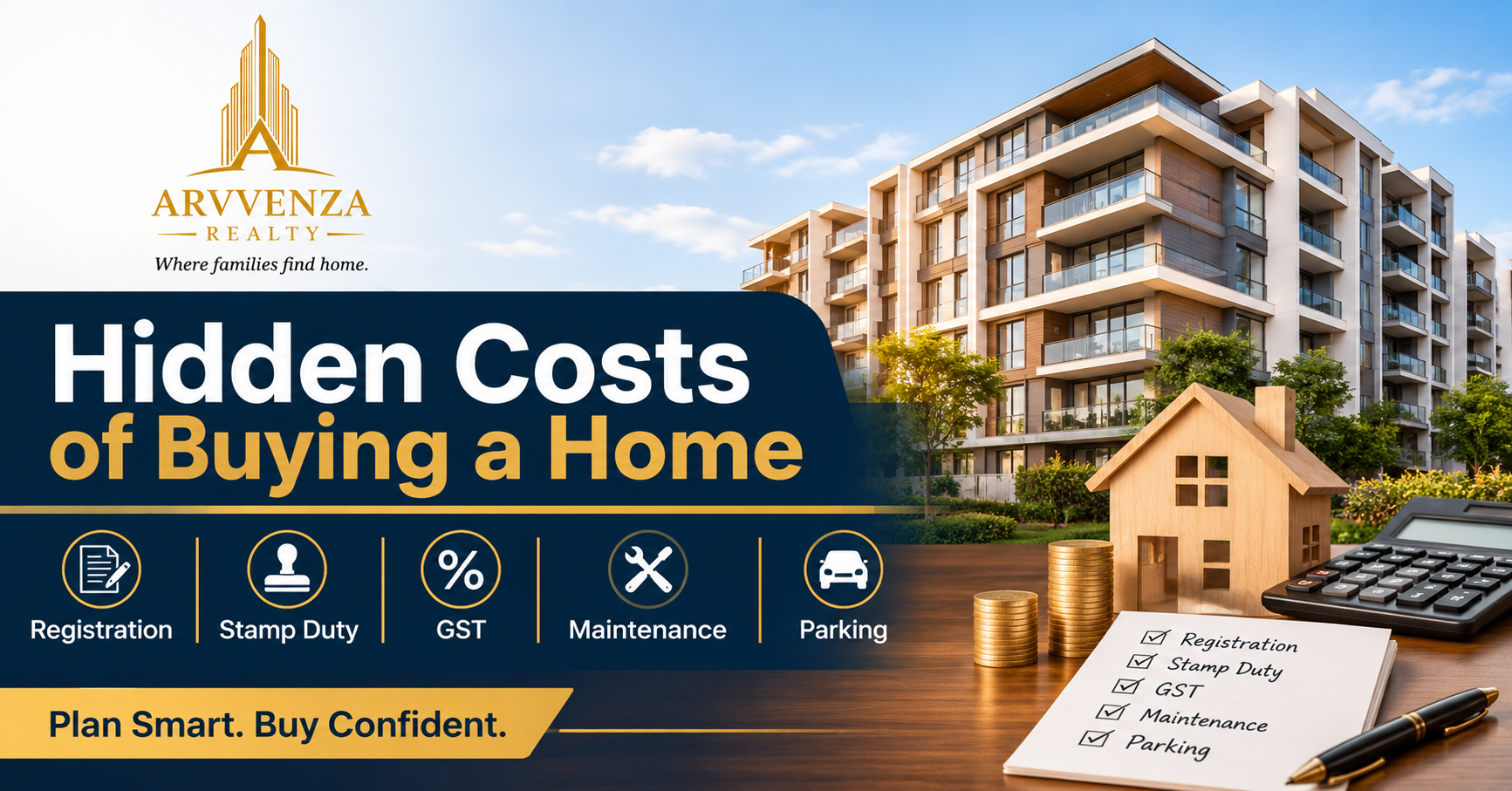
The hidden costs of buying a home are all the charges that
are in addition to the advertised price that you pay prior to, during and after
possession: stamp duty, registration fees, GST, parking, preferential location
charges, maintenance deposits, loan fees etc. They can add up to a significant
amount so you need to budget for the total cost rather than just the figure on
the brochure.
The vast majority of buyers will have set a budget off the
headline price and then discover the rest of the cost later, often when the
cost sheet comes through or at the registration office. By that stage the
booking amount is already paid and you're pretty much stuck with what you've
got. A bit of planning upfront is the only way to avoid that situation.
This guide lists every major extra cost, explains when you
pay it and what to ask about it and shows you how to put together your own
total cost sheet prior to booking. It includes notes for buyers in Gurugram,
Bangalore and Dubai. At Arvvenza Realty our residential property advisory team will walk the
buyer through the full cost of a purchase and that's the approach we recommend.
Quick note:
the rates in this guide are based on publicly available information at the time
of writing (November 2026) and are for information only. The tax, fee and
circle rate regimes are all subject to change on a regular basis and vary by
state/country, buyer category and project. You should always confirm the
current rates with the developer, the relevant government portal and a
qualified professional prior to any commitment.
Hidden Costs of Buying a Home at a Glance
Some costs are the government's, some are the developer's,
some are the lender's and some only come after you've moved in. The table below
shows each of these and when they typically arise.
|
Cost |
When
you pay |
What
to ask |
|
Stamp duty |
At registration |
Which value is it charged on:
agreement value or the government benchmark? |
|
Registration fee |
At registration |
Is there a cap or a flat rate in
this state? |
|
GST |
With instalments on
under-construction homes |
Is it included in the quoted price
or extra? |
|
TDS (a deduction, not a fee) |
When you pay the seller, if the
value is above the threshold |
Who handles the filing and
certificate? |
|
Preferential location charges |
In the payment plan |
What justifies the premium for
this unit? |
|
Parking |
At booking or in the payment plan |
Covered or open, one slot or two,
and is it free or paid? |
|
Club membership and amenities |
In the payment plan or at
possession |
Is it one-time, and is it
refundable? |
|
Maintenance deposit and advance
maintenance |
At possession |
For how many months, and who holds
the money? |
|
Corpus or sinking fund |
At possession |
How is it used and who manages it? |
|
Power backup, water, electricity
and gas connections |
At possession |
Which connections are included in
the price? |
|
Legal, documentation and loan fees |
During the purchase |
Which of these can be negotiated
or avoided? |
|
Interiors, furnishing and moving |
After possession |
What is my realistic budget for
the first year? |
|
Monthly maintenance, property tax
and utilities |
Ongoing |
What is the current monthly charge
for similar homes here? |
Government Charges You Cannot Avoid
These are set by the state / central government so the
developer can't opt them out of. You have to budget for them first.
Stamp Duty
Stamp duty is a state tax which is payable at the time of
registration of the sale. It's normally calculated on the higher of the
agreement value and the government's benchmark value for the area (this is
known as the circle rate, guideline value or guidance value depending on the
state). So an increase in the benchmark can lead to an increase in your duty
even if your agreed price has not changed.
What to check:
- The exact rate for your state, location (urban or
rural) and buyer category
- Whether women, joint owners or senior citizens get a
concession in your state
- The current benchmark value for the property, from the
official portal
- Whether cess or surcharge applies on top of the base
rate (it does in Karnataka)
Registration Fee
The registration fee is the fee charged for the recording of
the sale deed in the sub-registrar's office. This is separate from the stamp
duty. Some states charge a percentage of the value and others have a cap or a
fixed amount. Karnataka for instance doubled its registration fee in August
2025 so older articles are very much out of date.
What to check:
- The rate or cap applicable on the date you register
- Whether the fee is calculated on agreement value or
benchmark value
- Any separate charges for documentation, biometrics or
e-stamping
GST on Under-Construction Homes
GST applies to homes purchased from a developer prior to the
issue of the completion or occupancy certificate. For the vast majority of
residential units it's 5% without input tax credit and 1% for homes that
qualify as affordable housing (i.e. where the price is up to ₹45 lakh, with
carpet area restrictions of 60 sq m in metro cities and 90 sq m elsewhere). The
GST rates on housing were not changed in the September 2025 rate revision. GST
generally does not apply to a ready home with a completion certificate or to a
resale.
What to check:
- Whether the quoted price includes GST or adds it on top
- How the developer arrives at it. GST is normally
calculated after allowing a notional share for the land (usually one
third), so request to see the working in writing.
- Whether the unit's status (under construction or
completed) is clearly stated in the agreement
TDS on Property Purchases
TDS is not an additional charge. It has an impact on your
cash flow and compliance. If the value of the property is ₹50 lakh or more and
the seller is a resident, the buyer is required to deduct 1% of the amount paid
and deposit it with the tax department. The 1% is on the full value of the
property, not just the amount above ₹50 lakh. From 1st April 2026 this will be
in Section 393 of the Income-tax Act, 2025 (replacing Section 194-IA) and the
forms will be different too. Different rules apply where the seller is a
non-resident.
What to check:
- Whether your property crosses the threshold, and
whether payments are made in instalments
- How the deduction, deposit and certificate for the
seller will be handled
- That you do this on time, because late compliance can
lead to interest and penalties
- Your tax professional's advice on the current forms and
deadlines
Developer and Project Charges to Look For
These are the charges that most often catch the buyer out as
they're in the fine print of the cost sheet. They're set by the developer so
many of them are open to question and can be compared between projects. If
you're looking at a new launch our new project sales team can assist you in
comparing cost sheets side by side.
- Preferential location charges (PLC's) a premium for a better floor, a park facing view, a
corner unit or a position off the lift. Find out how the developer arrived
at the premium and whether it applies to your unit.
- Parking charges.
Some schemes will include one slot in the price, others will sell parking
separately and covered and open slots may be at different rates. You need
to check the number of slots, the type and whether the slot is in writing.
- Club membership and amenity fees. A one off fee for access to the clubhouse and facilities. Find
out if it's refundable and whether there are any monthly usage fees as
well.
- Maintenance deposit and advance maintenance. A lot of developers will take several months or indeed
several years of maintenance in advance plus a security deposit. Find out
who the money is held by and how it's transferred to the Residents'
Association.
- Corpus or sinking fund (a reserve for major repairs). Ask for the amount, how
it's managed and whether it's separate from the maintenance deposit.
- Power backup, water, electricity and gas connections. Some of the projects will charge you per connection or
per unit of backup capacity. You need to check which of these are included
in the price.
- External and infrastructure development charges. In some cases (e.g. Haryana) these charges for
external and infrastructure development can be passed on to the buyer.
Make sure they are included in the quoted price.
- Legal and documentation fees. Fees for drafting the agreement, registration
assistance or transfer. Need to find out which of these are mandatory.
- Interest on late payments. If you miss an instalment you'll be charged interest
so check what the rate is and whether the same rate will apply to the
developer if possession is delayed.
Ask that every charge be set out in the agreement for sale
with the amount and the basis for it. A charge which is only mentioned in words
is very difficult to challenge later on.
Loan, Move-In and Running Costs
The costs that come after the purchase are what will
determine whether your monthly budget remains comfortable. Plan for them prior
to purchase, not after you've taken ownership.
Home Loan Costs
- Processing fee and administrative charges charged by
the lender
- Legal, technical and valuation fees for checking the
property
- Loan insurance, if you choose or are offered a cover
- Pre-EMI interest on the amount disbursed while an
under-construction home is being built
- Prepayment and foreclosure terms (which should be
checked with the lender) even if under current RBI rules floating rate
loans to individuals generally wouldn't have such charges.
- Your own down payment, which is usually the largest
cash outlay at the start
Move-In Costs
- Interiors, modular fittings, appliances and furniture
- Moving, packing and transport
- Brokerage or advisory fees, where applicable
- Rent you may continue paying if possession is delayed,
on top of your EMI
Running Costs
- Monthly maintenance charges (usually on a per sq ft
basis) covering security, lifts,
housekeeping, water and common electricity. These will generally go up
over time so it's worth asking what the current rates are for similar
projects.
- Property tax.
Levied annually by the local municipal body.
- Utilities: electricity,
water, gas and internet plus any charges for use of shared facilities.
- Insurance.
A home insurance policy (for structure and contents) is definitely
something you should budget for.
- Repairs and maintenance: painting, waterproofing and appliance replacement (the
latter being particularly important in a villa or independent house).
A useful rule of thumb is to work out your first year's cost
of ownership rather than just the price. If you're still in the process of
deciding on a format then have a look at our guide to apartment vs villa vs plot to see the difference
in running costs.
How to Build Your Own Total Cost Sheet
A total cost sheet takes all the disparate charges and turns
them into one figure which you can then compare across projects. You need to do
this before you pay the booking amount.
- Ask the developer for a written cost sheet which
itemises every charge with the amount and the basis for that amount.
- Confirm whether the base price is on a per sq ft of
carpet area or super area basis and make sure you know exactly what area
you're buying.
- Add in the government charges using the official Stamp
Duty or Registration Calculator for your state.
- Add GST if the home is under construction and check how
the GST has been calculated.
- Add the one off developer costs: parking, PLC, club
membership, deposits, connection fees.
- Add in the loan costs, the legal fees and your down
payment requirement.
- Add in the move-in costs and a real first year running
cost.
- Add a cash buffer for the things you didn't anticipate,
then compare that total with your actual savings and your loan
eligibility.
Use this template and populate it with the figures for each
project you are comparing.
|
Line
item |
Basis |
Your
amount |
|
Base price |
Carpet or super area times rate |
|
|
Preferential location charges |
Per unit |
|
|
Parking |
Per slot |
|
|
Club membership and amenities |
One-time |
|
|
GST (if under construction) |
As calculated by developer |
|
|
Stamp duty |
State rate on value |
|
|
Registration fee |
State rate or cap |
|
|
Maintenance deposit and corpus
fund |
At possession |
|
|
Connection and backup charges |
At possession |
|
|
Legal, documentation and loan fees |
As charged |
|
|
Interiors, furnishing and moving |
Your estimate |
|
|
First-year running costs |
Maintenance, tax, utilities,
insurance |
|
|
Cash buffer |
Your estimate |
|
|
Total cost of ownership |
|
|
If the total comes in higher than you'd expected you've got
a few options: you can negotiate the developer's charges, you can compare it to
a similar project which has a cleaner cost sheet, you can go down to a smaller
unit or you can reduce the interiors budget.
Hidden Costs in Gurugram, Bangalore and Dubai
The categories are the same everywhere but the rates and
rules are local. The figures below were publicly available at the time of
writing and are subject to change so you should check each one on the official
portal prior to budgeting.
Gurugram (Haryana)
Haryana stamp duty is dependent on whether the property is
in an urban or a rural area and on the buyer category. The urban rates are
generally quoted as 7% for a male buyer, 5% for a female buyer and 6% for joint
ownership with a 1% registration charge on top (again, figures vary from source
to source and location to location so you'll need to check what it is in your
particular case). Benchmark (collector) rates have also been revised in parts
of Gurugram which can push the duty up on a given property. You'll also want to
find out whether the external and infrastructure development charges are
included in the price and what the maintenance and power backup charges are.
Read more about property in Gurugram, browse Gurugram
properties or view the current Gurugram
projects.
Bangalore (Karnataka)
Karnataka is a slab rate state with duty at approximately 2%
on properties up to ₹20 lakh, 3% on properties from ₹21 lakh to ₹45 lakh and 5%
on properties above ₹45 lakh (plus cess and surcharge). The registration fee
was doubled from 1% to 2% of the value of the property with effect from 31st
August 2025 so any older articles citing 1% are now out of date. You should
estimate your duty on the Kaveri portal prior to finalising your budget and
check the khata status of the property as part of your legal due diligence.
Look at real estate in Bangalore, Bangalore
properties or current Bangalore
projects.
Dubai
Dubai has no GST or stamp duty in the Indian sense, but it
has its own set of fees:
- The Dubai Land Department transfer fee is 4% of the
purchase price. It's officially split between buyer and seller but in
practice the buyer will often pay it.
- Off-plan homes are registered through the Oqood system,
with a similar 4% registration fee, plus administrative charges
- Trustee and registration fees, commonly a few thousand
dirhams plus VAT, and a small title deed issuance fee
- If you take a mortgage, a mortgage registration fee
applies, along with valuation and bank charges
- Agent commission, often around 2% plus VAT, and a
no-objection certificate fee on resale purchases
- Annual service charges for building and community
upkeep
Some developers will absorb or subsidise part of the
registration fee on launches so do ask. For more information on Dubai real estate, Dubai
properties and current Dubai
projects see here. If you're buying from abroad our NRI and international property assistance page
will tell you all about how we can help you with the process.
Questions to Ask Before You Pay a Booking Amount
Take that list to your next meeting with a developer or
sales team and only tick the boxes when you have the answer in writing.
- What's the total price payable (including all charges
and taxes)?
- Is the GST included in the quoted price and if so how
has it been calculated?
- Is the price per sq ft on carpet area or super area?
- What are the preferential location charges and why do
they apply to my unit?
- How many slots are there (what type and at what rate)?
- What are the club membership, connection and power
backup charges?
- How much maintenance is held in advance? Who holds the
deposit and the corpus fund?
- Are the external and infrastructure development charges
included?
- What's the expected monthly maintenance and how will
that change?
- Which are the charges which are fixed in the agreement
and which are capable of varying prior to possession?
Once your cost sheet is clear, check the project itself
using our Residential Property Buying Checklist.
How Arvvenza Realty Helps You See the Full Cost
At Arvvenza Realty we help the buyer look beyond the
headline price. We go through the pricing and payment plans with you, explain
the various charges that are associated with each project and then enable you
to compare them on a level playing field. We start with your budget, your
location, your property type and your purpose and then shortlist the properties
and help you to compare locations, projects and developers.
Our residential property services cover apartments, villas, plotted estates and premium residences in Gurugram and Bangalore with a selection of opportunities also available in Dubai. If you're looking for assistance in putting together a full cost sheet for a project you're looking at then do get in touch with a property advisor.
Conclusion: Budget for the Total Cost, Not the Brochure
Price
The price on the brochure is where your budget starts, not
where it ends. Stamp duty, registration, GST, parking, maintenance and move-in
costs all shape what you really pay, and most of them are predictable if you
ask early and get answers in writing.
If you are comparing homes in Gurugram, Bangalore or Dubai,
the team at Arvvenza
Realty can help you build a clear cost picture before you commit.
Explore our residential property services, read more guides
on our blog,
or contact
us to start your search.

Share This Post