
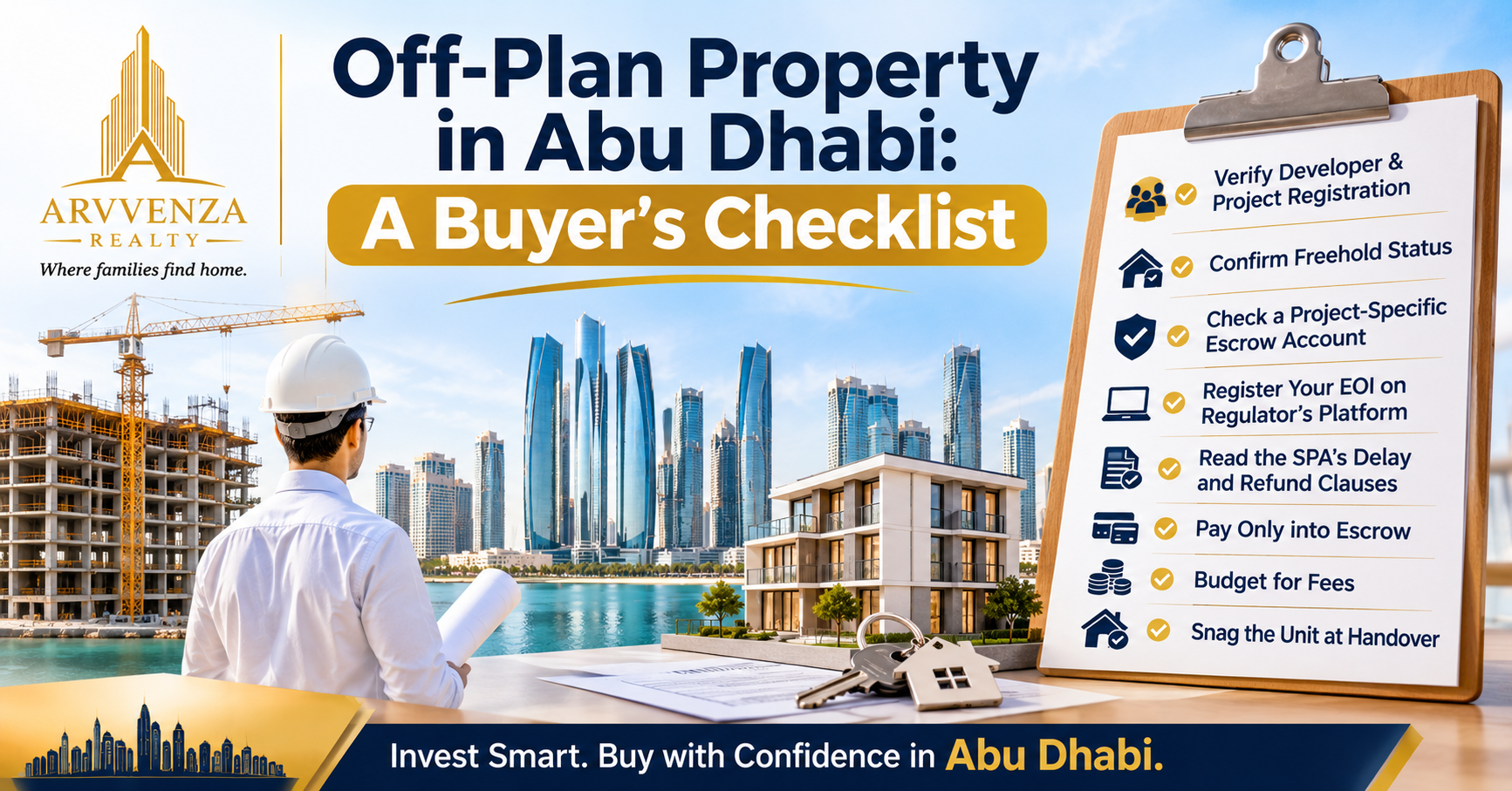
Off-plan property in Abu Dhabi lets
you buy early, pay in stages and choose from a wide range of homes. It is also
one of the most regulated ways to buy in the emirate, which helps, but only if
you know which protections exist and which checks are yours to make.
This checklist takes you from
shortlisting to handover. It uses Sobha City Abu Dhabi as a running
example. For the project's pricing and floor plans, see our Sobha City Abu Dhabi guide, or open the Sobha City Abu Dhabi property page.
How
Off-Plan Buying Is Regulated in Abu Dhabi
A few rules shape everything that
follows:
- ADREC
(the Abu Dhabi Real Estate Centre), working under the Department of
Municipalities and Transport (DMT), supervises developer licensing,
project registration and escrow.
- Every off-plan project needs its own escrow account. Developers can sell off-plan only after meeting
requirements such as approved plans, land rights, an escrow account and a
disclosure statement.
- The 20% rule.
Under Law No. 2 of 2025, the developer cannot withdraw from the escrow
account until at least 20% of construction works are complete. Escrow
funds also cannot be used to pay for the land or for broker commissions.
- Early release is limited. ADREC can approve earlier disbursement only if the
developer has been registered in Abu Dhabi for at least four years, has
delivered at least three projects on time and provides a bank guarantee of
at least 20% of construction cost.
- EOIs are digitised.
Since February 2026, Expressions of Interest for new off-plan launches
must be registered through ADREC's Madhmoun platform, with funds held in a
government-managed preparatory escrow account.
These rules reduce risk but do not
remove it. A badly drafted contract or a late project can still cost you time
and money.
Part
1: Before You Shortlist
- Check the developer's licence and project
registration. Confirm both the developer and the specific project with
ADREC through the DARI or TAMM platforms. Both registers are public.
- Review the delivery track record. Look at
previous handovers, quality and timeliness. Note that Sobha City is Sobha
Realty's first Abu Dhabi community, so ask about its delivery record
elsewhere and how it plans to deliver here.
- Confirm freehold status. Foreign buyers can
own freehold only in designated investment zones. Confirm the ownership
structure for your exact unit.
- Understand the master plan. Ask which phase
you are buying, what is built around it and what is only planned.
- Use a licensed broker. Verify both the
individual and the brokerage.
Part
2: Reservation and EOI
- Confirm the EOI is registered on Madhmoun
and that your deposit is held in the government-managed escrow, not paid
to an agent.
- Get the EOI terms in writing: amount,
refundability, and what happens if you do not proceed. For Sobha City,
listings report EOI amounts from around AED 35,000 for one-bedroom
apartments, so confirm the current figure.
- Keep every receipt and the booking form.
Part
3: Review the Sale and Purchase Agreement (SPA)
- Payment schedule: every instalment, its due
date and the milestone it is linked to. For Sobha City, the reported plan
is 20% on booking, 40% during construction (often eight 5% instalments)
and 40% on handover.
- Handover date and delay clause: what counts
as delay, any grace period and your remedies, including refund or
alternative-unit rights.
- Default and cancellation terms: the rules on
buyer default set refund and compensation levels, and developers must
follow notice procedures before terminating. Read them before you sign.
- Specifications and floor plan: the SPA
should list finishes, area and layout, so you can compare them at
handover.
- Service charges and community fees: reported
at around AED 16 per sq.ft. for apartments and AED 5 per sq.ft. for villas
at Sobha City, but confirm the current figures.
- Resale and NOC rules: whether and when you
can resell before completion, and what the developer charges.
- Project registration number: it should
appear in the contract.
- Have the SPA reviewed by a lawyer if the
amount is significant.
Part
4: Payments and Escrow
- Ask for the escrow account details (bank and
account name) and confirm they are project-specific.
- Pay only into that account. Never pay an
instalment to an individual, an agent or a different company.
- Check that your payment appears in the
escrow statement or developer receipt.
- Ask whether early escrow release is being used.
Early disbursement requires an ADREC-approved bank guarantee and a
developer with at least four years' registration in Abu Dhabi, so a
developer new to the emirate would not normally qualify. Ask the developer
directly.
- Know the registration step. Off-plan
purchases are recorded through DARI, and Abu Dhabi issues an interim
registration certificate, not Dubai's Oqood. The full title deed follows
at completion.
Part
5: Costs and Financing
- Registration fee: commonly cited at around
2% of the price. Confirm who pays and whether the developer offers any
waiver.
- Agency fees: often paid by the developer on
primary sales, but confirm.
- Total cost sheet: price plus fees plus
service charges, in writing.
- Financing plan for the handover payment. The
final instalment is the biggest, 40% on Sobha City's plan.
- Off-plan mortgage eligibility. ADREC's
framework lets lenders be recorded before handover, but participation is
confirmed project by project, so ask the bank and the developer.
- Overseas buyers: plan your remittances and
tax reporting early. See our guide for Indian buyers in Abu Dhabi.
Part
6: During Construction
- Track progress. Ask for construction updates
and compare them with your payment milestones. The DARI app can show
building progress and developer licence status.
- Review escrow statements from time to time.
- Keep your contact details current with the
developer, because legal notices are sent to the address on the contract.
- Raise delays early. If the developer does
not resolve a delay, you can complain through ADREC and TAMM, and ADREC
offers a dispute-resolution route as an alternative to court.
Part
7: Handover
- Wait for the completion notice and confirm
the developer has the required completion certificate.
- Snag the unit before final payment. Test the
AC, plumbing, electrics, doors, windows, seals, tiles and balconies.
Consider hiring a professional inspector.
- Get defects listed in writing, with a date
for fixing them.
- Settle final dues and service charge accounts.
- Collect keys, access cards and warranty
documents.
- Confirm the title deed process and timeline.
- Set up utilities and insurance.
Red
Flags to Walk Away From
- Pressure to pay quickly or to a personal account
- No project registration or escrow details
- A refusal to share the SPA before payment
- Promises of guaranteed returns or resale profits
- EOI collected outside the regulator's platform
- Vague handover dates with no delay remedy
- A broker you cannot verify
Sobha
City Abu Dhabi: The Checklist Applied
|
Checklist
item |
What
to ask for |
|
Developer and project registration |
Project registration number and
ADREC confirmation |
|
EOI |
Madhmoun registration, amount and
refund terms |
|
Payment plan |
Written schedule: 20% booking, 40%
construction, 40% handover (Q4 2029) |
|
Escrow |
Project escrow bank and account,
and whether early release is used |
|
Costs |
Registration fee, service charges,
any waivers |
|
Handover |
Completion certificate, snagging
window, title timeline |
|
Unit |
Floor plan, area and specification
list in the SPA |
For how the project compares with other communities before you decide, read Sobha City vs other Abu Dhabi master communities.
Questions
to Ask the Sales Team
- What is the project's ADREC registration number?
- Which bank holds the escrow account, and what is the
account name?
- Is the EOI registered on Madhmoun, and is it
refundable?
- What is the exact handover date and the delay remedy?
- What are the service charges per sq.ft. today?
- Who pays the registration fee?
- Can I resell before completion, and at what cost?
- Is the project eligible for an off-plan mortgage?
- What is included in the specification, and what is
optional?
- What happens if I miss a payment?
Talk to a Property Advisor
Tell us your budget, preferred home
type and timeline, and our new project sales team will help you run through this checklist for any
project you are considering.
View Sobha City Abu Dhabi on our website | Talk to a Property Advisor
WhatsApp: +971-585512150 | Call:
+91-7051112002 (India) / +971-585512150 (UAE)
Related Reading


Share This Post